
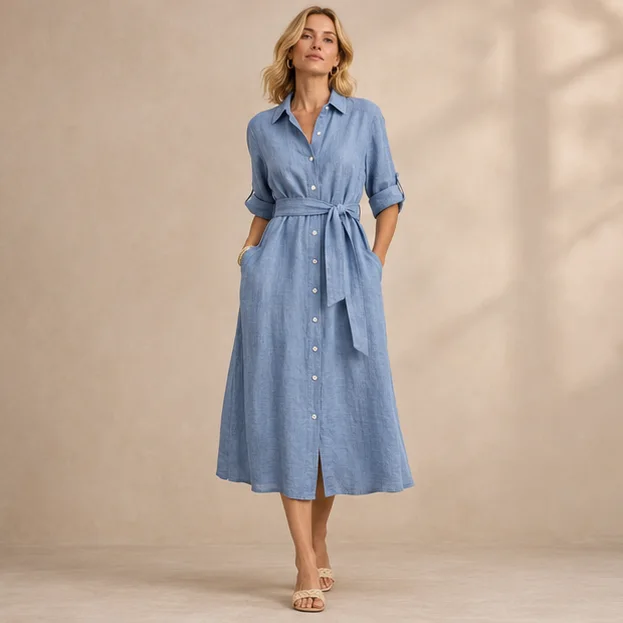
A soft tie waist or a crisp button front?
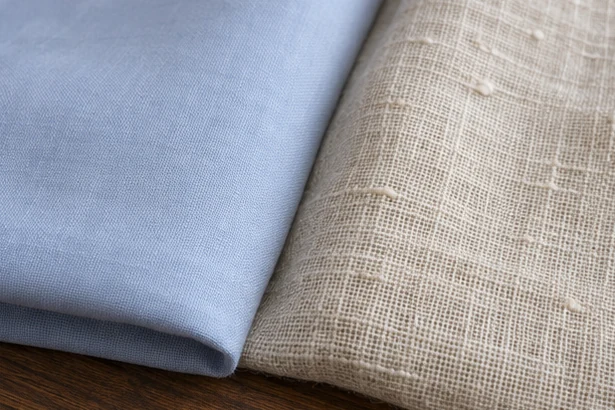
For a loose sleeve and a skirt that falls in soft folds, try a washed linen. A closely woven cotton poplin is a good first cutting for a sharp collar and a box pleat. If you want a soft waist and a crisp collar in the same dress, fold a collar stand in each cloth and try the interfacing you intend to use.
Linen comes from the stalk of the flax plant. Cotton fibers grow on the surface of cotton seeds. Either fiber can make a range of fabrics. Weight, construction and finish help explain why two swatches with the same fiber name behave differently when folded. Museum of Fine Arts Boston on linen and cotton.
Four details to try with the cuttings
A single layer tells you little about the bulk where four layers meet at a collar stand. Request cuttings large enough to fold the button front and gather a section of skirt.
| Pattern detail | Trial | What to look for |
|---|---|---|
| Button front | Fold the placket to its finished width with the proposed interfacing. | Does the front hang straight? Is it stiff enough to pull the rest of the dress out of shape? |
| Side pocket | Slip the proposed pocket lining behind a single layer of shell. | Can you see the pocket outline in indirect daylight? |
| Gathered waist | Gather the same length of each cloth into the same waistband width. | Do the gathers round out or bunch at the seam? |
| Tie belt | Tie and release two strips cut to the same width. | Which folds would you want to see across the waist of the dress? |
Give both suppliers the target color and weight range. Check that each cutting has the finish proposed for production. Linen fabric options and cotton fabric options.
What changes after sitting and washing?
Use the same pattern, size, pocket construction and seam allowances for both samples. Have one person try both dresses with the intended underlayer. Take front and side photos before sitting and after the same time seated. Daylight can reveal a pocket bag that was hard to see in the fitting room.
Before the proposed care cycle, mark the bust width, waist seam and center-back length. Measure again after drying and take a photo before pressing. A second photo after pressing, using the proposed care instructions for each garment, shows how much work it took to restore the finish.
An approval note the cutting room can use
“Use linen swatch L2 with the lighter pocket bag from the second fitting. Keep the soft waist gathers and the current collar stand.” Attach the front and side photos and the finished measurements to that swatch. For an approved poplin, identify the finish and interfacing that gave the collar its shape.